Agentic AI Security: Why Your Autonomous Workforce Is Your Biggest Insider Threat in 2026

If you deployed AI agents in 2025, congratulations—you've likely introduced the most capable insider threat your organization has ever faced. Recognizing this is crucial for cybersecurity professionals to understand the gravity of the emerging risks.
The final week of January 2026 delivered a stark reminder of where the AI security landscape is heading. From Google's takedown of a massive proxy network exploited by 550+ threat groups to the emergence of specialized security tools designed specifically for agentic AI, one message is clear: the security frameworks we've relied on for decades weren't built for autonomous systems.
The Week That Changed the AI Security Conversation
Google's IPIDEA Disruption Reveals the Scale of AI-Enabled Threats
On January 29, 2026, Google's Threat Intelligence Group (GTIG) disrupted IPIDEA, revealing the vast scale of AI-enabled threats with over 550 threat groups exploiting residential proxy networks, underscoring the urgent need for advanced AI security measures.
The network operated through 600+ trojanized Android apps and over 3,000 compromised Windows binaries. These weren't sophisticated zero-days—they were commodity tools that enrolled millions of devices into botnets like BadBox 2.0.
Why does this matter for AI security? Because the same infrastructure that enables credential stuffing and ad fraud is increasingly being weaponized for AI-powered attacks. When attackers can route AI-driven reconnaissance through millions of residential IP addresses, traditional perimeter defenses become nearly useless.
The Agentic AI Security Crisis Takes Center Stage
January 30 brought a wave of product announcements that tell a more nuanced story. MIND announced its DLP for Agentic AI, specifically designed to address the reality that autonomous agents can "create, access, transform and share data across SaaS applications, local devices, homegrown systems and third-party tools."
Meanwhile, Booz Allen Hamilton made Vellox Reverser generally available—an agentic AI-powered malware analysis tool that can dissect complex threats in under three minutes. The irony isn't lost on security professionals: we're now deploying AI agents to protect against the risks created by AI agents.
Why Traditional Security Frameworks Are Failing
The Identity Crisis No One Talks About
Here's a statistic that should keep every CISO awake at night: machine identities now outnumber human identities by a ratio of 82 to 1. In some enterprise environments, security scans are discovering anywhere from one to seventeen AI agents per employee.
The OWASP Top 10 for Agentic Security now explicitly distinguishes between the risks of what AI says versus what AI does. This isn't just a semantic difference—it represents a fundamental shift in attack surface management.
Traditional DLP was designed for predictable, human-driven workflows. But as MIND's research indicates, agentic AI operates at machine speed and acts autonomously, often without the contextual awareness to recognize when it's being manipulated.
Agency Hijacking: The New Attack Vector
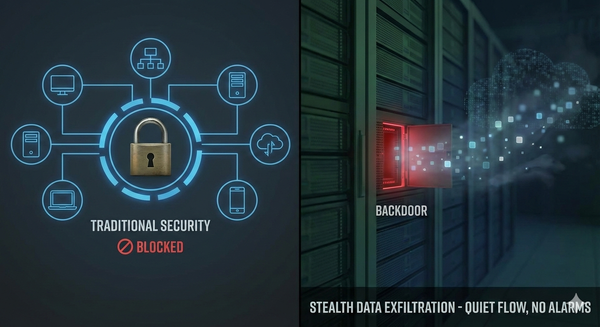
Forget prompt injection—the real threat is "agency hijacking." According to Palo Alto Networks' Chief Security Intel Officer Wendi Whitmore, adversaries can now use "a single, well-crafted prompt injection or by exploiting a 'tool misuse' vulnerability" to gain an autonomous insider that can "silently execute trades, delete backups, or pivot to exfiltrate the entire customer database."
This isn't theoretical. The attack surface includes:
- Memory manipulation: Corrupting an agent's context window to alter decision-making
- Tool abuse: Exploiting legitimate integrations (APIs, databases, file systems) for unauthorized actions
- Identity spoofing: Forging machine identities to trigger automated cascading actions
A Practical Framework for Agentic AI Security
Based on industry best practices emerging in early 2026, here's a methodology your security team can apply immediately:
1. Conduct an AI Agent Inventory
You cannot secure what you cannot see. Before your next board meeting, answer these questions:
- How many AI agents have access to production systems?
- Which agents can create, modify, or delete data?
- What's the blast radius if any single agent is compromised?
2. Apply Zero Trust to Non-Human Identities
Treat every AI agent like an untrusted contractor on day one. Implement:
- Least-privilege access with time-bound credentials
- Behavioral baselining with anomaly detection
- Microsegmentation between agent workloads
3. Implement Data-Centric Controls
Rather than trying to secure every agent interaction, focus on protecting the data itself. Emerging solutions like MIND's DLP for Agentic AI provide visibility into which agents are accessing sensitive data and can autonomously remediate issues as they arise.
4. Establish Kill Switches
Every agentic deployment should include automated circuit breakers that can:
- Revoke agent credentials instantly
- Isolate compromised workloads
- Preserve forensic evidence for incident response
Common Mistakes to Avoid
Treating AI agents as you would human users. Agents don't forget passwords, but they also don't exercise judgment. They'll execute malicious instructions with the same efficiency as legitimate ones.
Assuming your AI vendor handles security. The shared responsibility model applies here. Your vendor secures the model; you ensure the deployment, integrations, and data access.
Waiting for regulatory clarity. While the federal executive order on AI policy creates uncertainty around state-level enforcement, the threats aren't waiting. Build your security program now and adapt as regulations mature.
Looking Ahead: The Regulatory Landscape
Data Privacy Week 2026 (January 26-30) emphasized "Take Control of Your Data"—a theme particularly relevant as AI agents increasingly mediate our relationship with sensitive information. Meanwhile, New York's RAISE Act now requires frontier AI developers to publish detailed safety plans, including cybersecurity measures to prevent model theft.
The message from regulators is clear: if you can't explain how your AI systems handle data, you're not ready for the compliance scrutiny that's coming.
The Bottom Line
The agentic AI revolution is here, and it's moving faster than most security programs can adapt. Recognizing this urgency can motivate organizations to act decisively and prioritize AI security as a core business function.
Sources
- Google Cloud Blog: Disrupting the World's Largest Residential Proxy Network - January 29, 2026
- Help Net Security: New infosec products of the month - January 2026 - January 30, 2026
- Help Net Security: MIND DLP for Agentic AI - January 28, 2026
- Help Net Security: Booz Allen's Vellox Reverser - January 26, 2026
- The Register: Unaccounted-for AI agents are being handed wide access - January 29, 2026
- The Register: AI agents 2026's biggest insider threat
- Globe Newswire: National Cybersecurity Alliance Launches Data Privacy Week 2026
- King & Spalding: New State AI Laws Effective January 1, 2026
- OWASP AI Agent Security Top 10 - 2026