AI Spending, Night-Sky Power, and Rare-Earth Shortages: Three Technology Trends Every IT Leader Needs on Their Radar
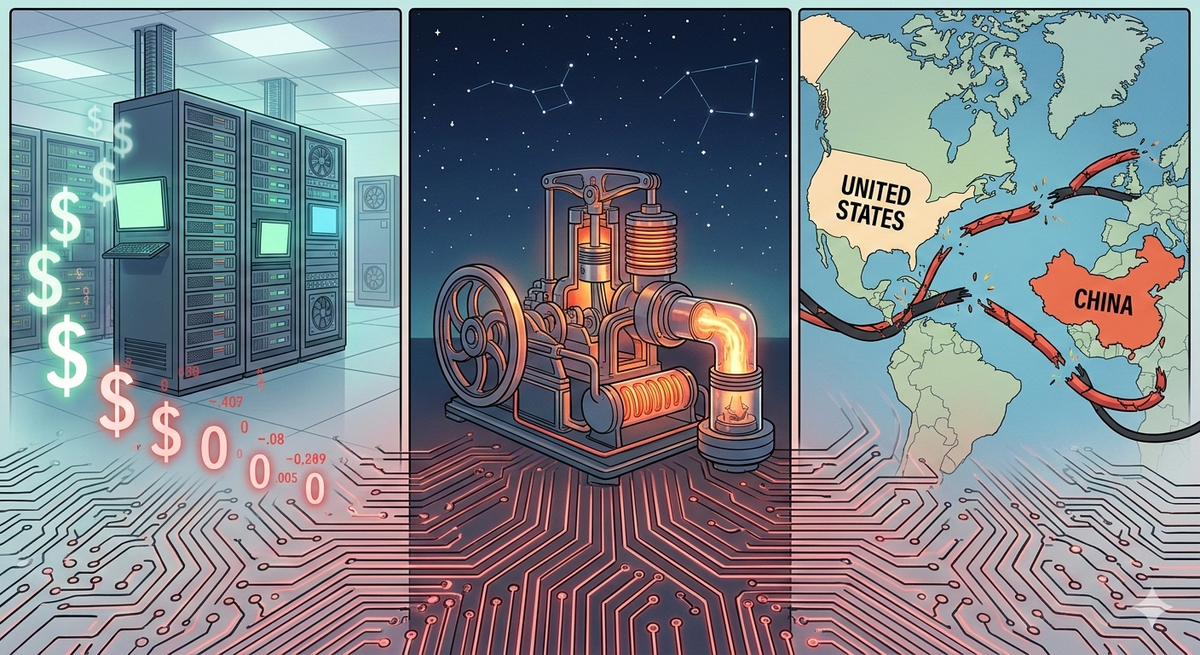
Three stories about AI economics, alternative energy, and critical mineral supply chains all point to one important theme for CISOs, IT directors, and business executives: the gap between hype and real-world results is growing. Organizations that plan for this now will be better prepared for the future.
Let’s look at each one in detail.
Massive AI Investment Contributed "Basically Zero" to U.S. Economic Growth
Goldman Sachs Chief Economist Jan Hatzius made waves in February 2026 when he stated that AI investment contributed "basically zero" to U.S. GDP growth in 2025. His colleague, economist Joseph Briggs, reinforced the point, telling The Washington Post that the prevailing narrative of AI-powered economic expansion was "an intuitive story" but one that doesn't stand up to scrutiny.
What Happened
The U.S. recorded approximately 2.2 percent GDP growth in 2025 based on the BEA's final 2025 GDP figure. Earlier estimates from the Federal Reserve Bank of St. Louis suggested that AI-related investment accounted for roughly 39 percent of Q3 2025 GDP growth, and Harvard economist Jason Furman attributed 92 percent of first-half growth to information processing equipment and software. Goldman Sachs is now pushing back hard on those figures.
Their point is straightforward: most AI spending leaves the U.S. When a major U.S. tech company builds a data center, up to 75% of the investment goes to components made in Taiwan, South Korea, and other semiconductor centers. This boosts their economies, not America’s. The top five U.S. tech companies are expected to spend up to $700 billion on AI infrastructure in 2026.
Why IT Leaders Should Care
This isn’t a case against AI. It’s a warning about building your strategy on hype instead of facts. A recent survey of nearly 6,000 executives in the U.S., Europe, and Australia found that while 70 percent of firms use AI, about 80 percent saw no clear impact on jobs or productivity.
Actionable takeaway: If your organization is investing in AI, connect every dollar spent to a clear internal result, such as reducing cycle time, speeding up incident response, or avoiding costs. Don’t rely on market hype to justify your ROI. Goldman Sachs Research predicts AI may not affect GDP until 2027, so use this time to implement a proven measurement approach. Consider using a structured ROI framework, such as OKRs (Objectives and Key Results) or a balanced scorecard, both of which can help you link your AI spending to specific, measurable business outcomes. Setting up this type of framework now ensures you will have meaningful data before the board asks tougher questions.
Common Mistakes to Avoid
Don’t mistake spending on AI for actually benefiting from it. Many organizations buy AI tools without having the right data management, integration systems, or staff training to get real value. The costs appear on your financial statements right away, but any productivity gains may take months or even years to show up—if they come at all.
UC Davis Engineers Build a Device That Creates Power at Night Using the Cold of Outer Space
While debates over AI investment fill boardrooms, engineers at the University of California, Davis have quietly demonstrated something impressive: a device that generates mechanical power at night by exploiting the temperature difference between Earth’s surface and outer space.
How It Works
The device uses a Stirling engine, a heat engine design that has been around for centuries, combined with a specially coated panel that sends infrared energy into the sky. At night, the panel’s cold side releases heat into space and cools below the air temperature, while the warm side absorbs heat from the ground. This temperature difference, often just 10 degrees Celsius, is enough to power a piston and flywheel all night. The UC Davis team published their results in Science Advances, showing they generated at least 400 milliwatts of mechanical power per square meter over a year of nighttime tests.
Why IT Leaders Should Care
Four hundred milliwatts per square meter isn’t enough to run a data center. Still, this technology could be important for edge computing, remote sensor networks, and off-grid IoT systems. Consider environmental monitoring stations, agricultural IoT setups, or remote telecom relay sites. In these places, generating power at night with a simple, low-maintenance device could reduce battery use and keep systems running longer. While the UC Davis device is still at the research and prototype stage, experts suggest that early commercial versions could become available within the next three to five years, once efficiency and manufacturing scale improve. IT leaders should monitor this timeline to identify potential opportunities for pilot projects or integration into remote infrastructure.
For CISOs, this technology matters for securing distributed physical infrastructure. Each sensor node that can run without a battery change or generator means fewer maintenance trips and fewer times someone needs to access the site physically.
Framework for Evaluation
When looking at new energy technologies for IT infrastructure, consider four things: power density (can it handle your workload?), geographic limits (this device works best in dry areas with clear night skies), maintenance needs (passive systems cost less to run), and how easily it fits into your current power setup. The UC Davis device performs well in maintenance and integration, but it doesn’t yet provide enough power for anything beyond low-energy edge devices.
Rare-Earth Shortages Worsen for U.S. Aerospace and Semiconductor Suppliers
The third story carries the most urgent operational risk. Reuters reported in late February 2026 that suppliers to U.S. aerospace and semiconductor companies are facing worsening shortages of critical rare-earth elements, with at least two suppliers reportedly turning away clients.
What's Happening
The shortages focus on yttrium and scandium, two of the 17 rare-earth elements that are almost all produced in China. Yttrium is needed for coatings that keep jet engines and industrial turbines from overheating. Scandium is important for making chip parts used in 5G smartphones and base stations.
Since shortages were first reported in late 2025, yttrium prices have surged roughly 60 percent and now stand nearly 70 times higher than a year ago, according to current commodity pricing data. The United States currently has no domestic scandium production and lacks fully operational alternative supply sources outside China. Industry sources indicate that existing stockpiles may last months, not years.
Even after the U.S. and China eased trade tensions in October 2025, Chinese customs data shows these materials still rarely reach American buyers. A possible Xi-Trump summit in Beijing might address the problem, but IT and procurement leaders shouldn’t wait for diplomacy to solve it.
Why IT Leaders Should Care
If your infrastructure relies on semiconductor components—and in 2026, that’s almost everyone—this is a supply chain risk you need to address now. The effects are clear: longer wait times for networking gear, server hardware, and 5G components. If you’re in the middle of a hardware refresh or planning to expand, timelines that seemed fine six months ago may no longer work.
Actionable recommendations:
- Audit your hardware pipeline. Identify any pending orders or planned purchases that depend on components with rare-earth inputs, particularly 5G and aerospace-adjacent technology.
- Engage your vendors early. Ask direct questions about supply chain exposure to Chinese rare-earth restrictions. Vendors who can't answer clearly are a risk.
- Diversify where possible. Evaluate whether alternative component suppliers or substitute materials exist for your most critical infrastructure needs.
- Extend lifecycle planning. If replacements are going to take longer to arrive, invest in protecting and securing what you already have. Patch management, firmware updates, and hardware monitoring become even more important when you can't quickly swap failing equipment.
Common Mistakes to Avoid
Don’t assume a trade deal will fix a deep supply problem. Even if relations improve, the U.S. still produces almost none of the key rare-earth elements, posing a long-term risk. Base your IT procurement strategy on supply chain resilience, not hope.
The Connecting Thread: Plan for Reality, Not Headlines
These three stories all teach the same lesson. The AI investment story promised big economic change, but reality gave us only a small impact. Night-sky energy sounds like science fiction, but in reality, it produces 400 milliwatts and is a new option for edge infrastructure. Rare-earth trade deals promised relief, but shortages have only gotten worse.
The organizations that succeed in 2026 will be those that base their strategy on real, verified data, not broad market stories. To act on these lessons, IT leaders should use the following checklist:
- Define and measure internal ROI for each AI investment, using structured frameworks such as OKRs or balanced scorecards.
- Track and evaluate emerging energy technologies for potential integration, especially those that could benefit edge and remote infrastructure.
- Assess and mitigate supply chain risks related to rare-earth materials by auditing hardware dependencies, engaging vendors on sourcing, and extending existing equipment lifecycles.
- Monitor market data and technology developments regularly to update strategy based on factual outcomes rather than predictions or hype.
Sources
- Goldman Sachs Chief Economist Jan Hatzius and economist Joseph Briggs, as reported by The Washington Post (February 23, 2026): How much did AI boost the economy? Maybe zilch, some economists say.
- Tom's Hardware (February 2026): AI boosted the US economy by 'basically zero' in 2025, says Goldman Sachs chief economist
- UC Davis News: Mechanical Power by Linking Earth's Warmth to Space
- Science Advances (November 2025): UC Davis Stirling engine research publication
- Reuters / Mining.com (February 25, 2026): Rare earth shortages worsen in US aerospace, chips despite trade truce
- Yahoo Finance: AI contributed 'basically zero' to the US economy last year, according to Goldman Sachs
- Modern Diplomacy (February 26, 2026): Rare Earth Squeeze Deepens for U.S. Aerospace and Chipmakers