NVIDIA's Historic $20 Billion Groq Deal Reshapes AI Chip Landscape
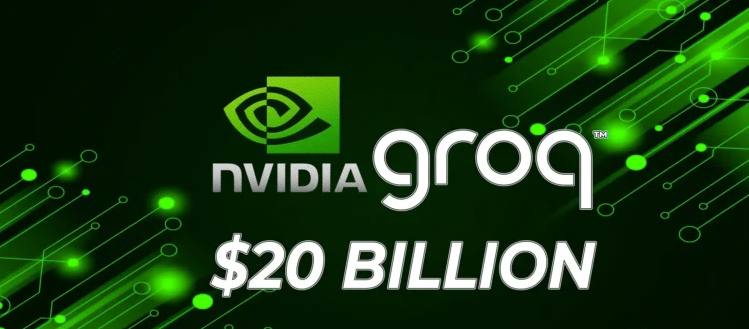
The AI hardware industry experienced a significant market shift on Christmas Eve when Nvidia announced a $20 billion licensing deal with Groq, its largest transaction to date, signaling a new era in AI chip competition. This move is crucial for understanding how Nvidia aims to strengthen its position in AI training and inference workloads, which is vital for industry professionals tracking market shifts.
Breaking: Nvidia Licenses Groq's Inference Technology for $20 Billion
The Deal: Groq announced on December 24, 2025, that it has entered into a non-exclusive licensing agreement with Nvidia for its inference technology. The agreement reflects a shared focus on expanding access to high-performance, low-cost inference capabilities.
Key Personnel Changes: Groq founder and CEO Jonathan Ross, President Sunny Madra, and other senior leaders will join Nvidia to help advance and scale the licensed technology. Simon Edwards, Groq's current finance chief, will step into the role of Chief Executive Officer.
What This Means for Your Organization:
The deal signals a significant shift in the AI hardware landscape, encouraging enterprise IT decision-makers to feel more confident about future infrastructure stability and strategic positioning.
Immediate Considerations:
• GroqCloud will continue to operate without interruption for existing users
• Organizations currently evaluating inference solutions should monitor Nvidia's roadmap announcements
• Expect new product offerings combining GPU and LPU technologies within 12-18 months
The "Reverse Acqui-Hire" Strategy: Regulatory Implications
By structuring the deal as a non-exclusive license, Nvidia reassures organizations that they retain flexibility, helping them feel more secure in their strategic choices.
"While we are adding talented employees to our ranks and licensing Groq's IP, we are not acquiring Groq as a company." — Nvidia Official Statement.
What This Means for Your Organization:
This deal structure may become a template for future tech consolidation. Organizations evaluating vendor stability should understand that Groq will continue as an independent entity, but its long-term strategic direction will likely align with Nvidia's ecosystem. Factor this into multi-year procurement decisions.
Why Groq's Technology Represents a Strategic Asset
Groq's LPUs, designed for inference workloads, offer a performance edge that can inspire industry professionals and investors to consider new AI hardware strategies.
Market Position: Founded in 2016 by former Google TPU engineers, including Jonathan Ross, Groq has grown its developer base from 356,000 to over 2 million in just one year. The company was valued at $6.9 billion following a $750 million funding round in September 2025.
What This Means for Your Organization:
The inference market is becoming the next battleground in AI infrastructure. As your organization scales AI deployments from pilot projects to production workloads, inference costs become a critical factor in TCO calculations.
Key Metrics to Watch:
• Inference cost per token for production LLM deployments
• Energy consumption metrics for AI workloads
• Latency requirements for real-time AI applications
Timeline: Nvidia's Path to AI Infrastructure Dominance
Date Event
In 2016, Groq was founded by former Google TPU engineers
2019 Nvidia acquires Mellanox for $6.9B (previously the largest deal)
Sept 2025 Groq raises $750M at $6.9B valuation; Nvidia hires Enfabrica CEO
December 24, 2025, Nvidia-Groq licensing agreement announced at $20 billion
Market Impact and Competitive Analysis
NVIDIA's Defensive Play: This transaction neutralizes a potential competitive threat. Groq had previously accused Nvidia of predatory tactics, claiming potential customers feared losing GPU allocation priority if caught engaging with competitors.
Broader Industry Context: Combined with Nvidia's announced $100 billion OpenAI investment commitment and $5 billion Intel partnership, the company is systematically securing control over every segment of the AI infrastructure value chain.
What This Means for Your Organization:
IT professionals should anticipate continued consolidation in the AI chip market. Consider:
• Evaluating cloud provider options that offer alternative silicon (Google TPUs, AWS Trainium/Inferentia)
• Monitoring AMD and Intel's competitive responses
• Assessing open-source inference optimization frameworks as hedge strategies
Actionable Takeaways for IT Leaders
- Immediate: No action required for current GroqCloud users—operations continue uninterrupted.
- Short-term: Monitor Nvidia's 2026 product announcements for LPU-integrated offerings
- Medium-term: Reassess inference infrastructure strategies as new hybrid GPU/LPU solutions emerge
- Long-term: Factor Nvidia's expanding market dominance into vendor risk assessments
Sources
- Groq Official Announcement - "Groq and Nvidia Enter Non-Exclusive Inference Technology Licensing Agreement" (December 24, 2025)
- CNBC - "Nvidia buying AI chip startup Groq's assets for about $20 billion" (December 24, 2025)
- TechCrunch - "Nvidia to license AI chip challenger Groq's tech and hire its CEO" (December 24, 2025)
- Bloomberg - "Nvidia Reaches Technology Licensing Deal With Startup Groq" (December 24, 2025)
- Tom's Hardware - "Nvidia buys AI chip startup Groq's assets for $20 billion" (December 25, 2025)