Third-Party Vendor Breaches Are Your Biggest Cybersecurity Threat in 2026: What CISOs Must Do Now
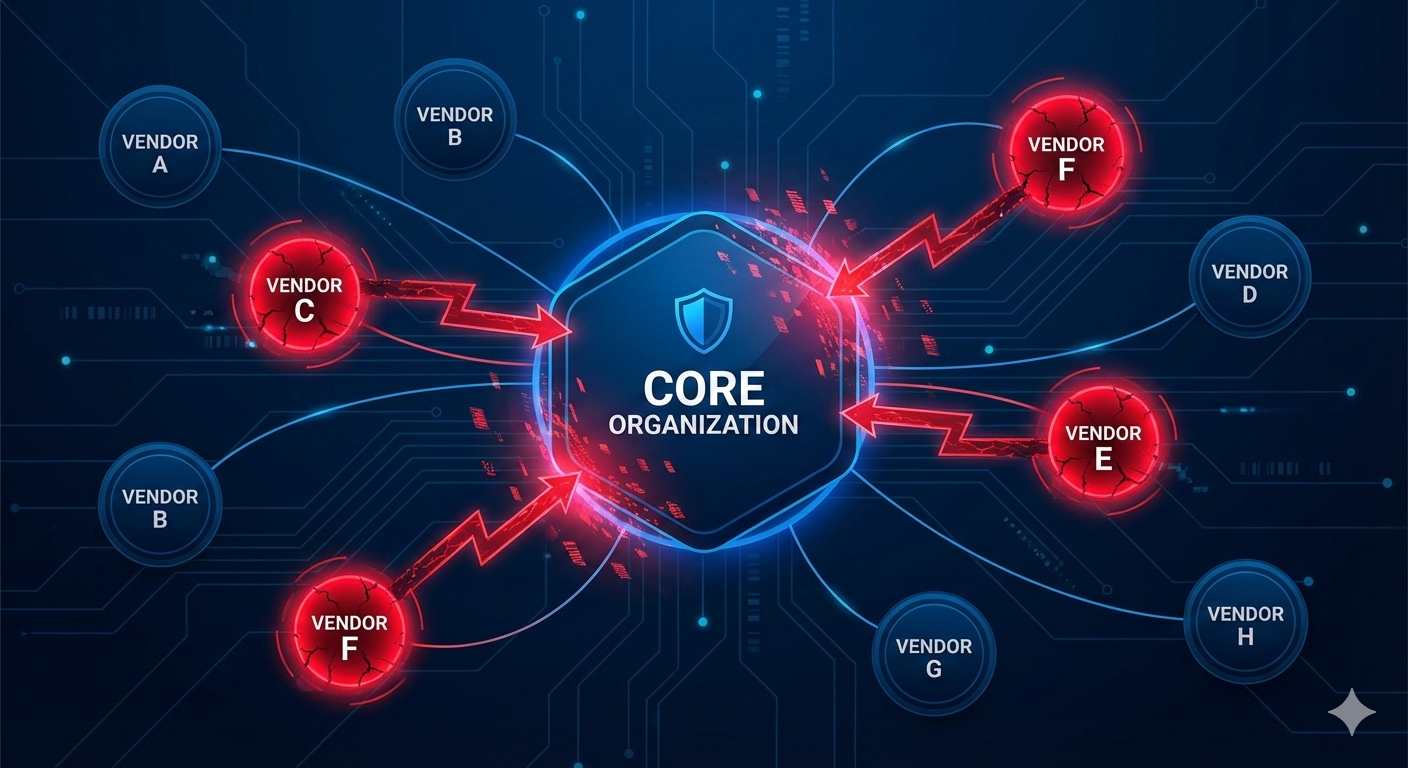
The first week of 2026 delivered a stark reminder: your most dangerous cybersecurity vulnerability may not be inside your network at all.
Between January 5 and 6 alone, a cascade of third-party-related breaches has been reported, each of which should alarm every security leader. Cryptocurrency wallet provider Ledger confirmed that customer data was exposed through its payment processor, Global-e. Telecommunications provider Brightspeed launched an investigation after threat actors claimed access to over 1 million customer records. And the aftermath of the Shai-Hulud supply chain attack continued to ripple through the industry, with Trust Wallet users losing $8.5 million through a compromised Chrome extension.
These aren't isolated incidents. They represent the dominant attack vector of 2026, and organizations that fail to adapt their third-party risk management programs will find themselves among the casualties.
The Shift in Attack Surface: Why Vendors Are the New Front Door
Modern enterprises operate within complex ecosystems. The average organization now manages 286 vendors, up from 237 in 2024, according to recent industry data. Each integration, API connection, and data-sharing agreement extends your attack surface beyond your direct control.
Threat actors have noticed. The Verizon 2025 Data Breach Investigations Report found that breaches involving a third party jumped to 30%, up from roughly 15% the previous year. SecurityScorecard's analysis puts the figure even higher at 35.5% of all breaches linked to third-party access.
The math is straightforward: why spend months trying to breach a well-defended enterprise when you can compromise a smaller vendor with weaker controls and inherit their trusted access?
What January 2026's Breaches Reveal
The recent incidents reveal patterns security leaders must understand to strengthen their confidence in risk management:
The Ledger/Global-e Breach demonstrates the "inherited trust" problem. Global-e, as Ledger's payment processor, maintained legitimate access to customer data, including names, contact information, and order details. When attackers compromised Global-e's cloud systems, they effectively bypassed Ledger's own security controls entirely. Ledger emphasized that its platform, devices, and recovery phrases remained secure—but for affected customers, that distinction offers cold comfort.
The Trust Wallet Attack illustrates supply chain compromise at the code level. The Shai-Hulud 2.0 attack targeted NPM registries, exposing Trust Wallet's GitHub secrets and Chrome Web Store API key. Attackers then published a malicious browser extension (version 2.68) that exfiltrated wallet recovery phrases. The attack affected 2,520 wallets before discovery, with stolen funds laundered through exchanges including ChangeNOW and FixedFloat.
The Sedgwick Government Solutions Incident shows that even organizations serving government agencies aren't immune. A file transfer system compromise at this benefits administrator subsidiary demonstrates how attackers target the operational infrastructure that connects vendors to their clients.
The Hidden Layers of Vendor Risk
Most organizations underestimate their vendor exposure because they only see direct relationships. In reality, your risk extends to:
- Fourth-party vendors: Your vendor's vendors, who may have access to your data through inherited permissions
- SaaS dependencies: Authentication brokers, payment processors, and API providers that sit between you and critical functions
- Developer tooling: Build systems, package registries, and deployment pipelines that can inject malicious code upstream
The Korean Air breach disclosed this week exemplifies this complexity. The airline's employee data (30,000 records, including bank account numbers) was compromised not through Korean Air's systems but through KC&D Service, a vendor that manages inflight catering and duty-free services. The Cl0p ransomware group reportedly exploited an Oracle E-Business Suite flaw in the vendor's environment.
The Evolving threat landscape underscores the need for security leaders to adopt proactive third-party risk strategies in 2026:Traditional third-party risk management programs built around annual questionnaires and checkbox compliance are no longer adequate. Here's what works:
Implementing continuous security monitoring is vital for security leaders to maintain control and stay ahead of vendor-related threats: annual assessments provide a snapshot that becomes obsolete within weeks. Deploy continuous monitoring solutions that track:
- Vendor security ratings and posture changes
- New vulnerabilities affecting vendor technology stacks
- Credential exposures and dark web mentions
- Certificate and domain anomalies
This isn't optional. When an attacker compromises a vendor, you need hours of detection time, not months.
2. Enforce the Principle of Least Privilege—Externally
Apply Zero Trust principles to every vendor relationship:
- Grant vendors only the minimum access required for their function
- Implement time-bound access that expires automatically
- Require re-authentication for sensitive operations
- Segment vendor access from your core network and critical assets
Ask yourself: if this vendor were compromised tomorrow, what could an attacker access through their connection?
3. Mandate Security Contractual Requirements
Build security into vendor agreements, not as an afterthought:
- Require SOC 2 Type II reports or equivalent attestations
- Include breach notification timelines (24-48 hours, not weeks)
- Specify incident response cooperation requirements
- Reserve audit rights for critical vendors
- Define data retention and destruction requirements
4. Map Your Fourth-Party Exposure
You cannot manage risk you cannot see. For critical vendors:
- Identify their key subcontractors and technology dependencies
- Understand where your data flows beyond the direct vendor relationship
- Assess concentration risk (multiple vendors depending on the same fourth party)
- Request supply chain transparency as part of vendor due diligence
5. Build Vendor Compromise Into Your Incident Response Plans
Your IR playbooks should include vendor breach scenarios:
- Communication templates for customer notification when a vendor is breached
- Procedures for rapid access revocation without breaking operations
- Alternative vendor arrangements for critical functions
- Legal and regulatory notification workflows specific to third-party incidents
Common Mistakes That Increase Third-Party Risk
Treating vendor risk as a procurement exercise. Security teams often inherit vendor relationships after contracts are signed. By then, you're negotiating from a position of weakness. Involve security in vendor selection from the start.
Relying on questionnaires alone. Vendors will answer questionnaires favorably. Technical assessments, security ratings, and evidence of controls (not just assertions) provide real insight.
Ignoring vendor tier classifications. Not every vendor needs the same scrutiny. Build a tiered model based on data access, system integration depth, and business criticality. Reserve deep assessments for your riskiest relationships.
Forgetting about sunset. Vendor relationships end. Ensure you have processes to revoke access, recover data, and verify deletion upon contract termination. Former vendors with lingering access represent unmonitored risk.
Assuming breach disclosure will be prompt. Many organizations learn about vendor breaches from news reports or threat intelligence—not from the vendor. Build detection capabilities that don't depend on vendor honesty.
The Regulatory Landscape Is Tightening
January 2026 brought new compliance requirements that elevate third-party risk management from best practice to legal obligation.
California's expanded privacy regulations, including the new cybersecurity audit requirements under the CCPA amendments, now mandate formal assessments of vendor security practices for businesses that handle significant data of California residents. The California Delete Act (DROP system) requires data brokers to honor deletion requests within 45 days, with per-violation penalties that apply to third-party processors as well.
New comprehensive privacy laws in Indiana, Kentucky, and Rhode Island took effect January 1, adding to the patchwork of state requirements. Meanwhile, federal regulators continue developing the Cyber Incident Reporting for Critical Infrastructure Act (CIRCIA) and expect the final rule by May 2026.
For organizations in financial services, healthcare, or critical infrastructure, the regulatory expectations around vendor oversight have never been higher. Demonstrating due diligence in third-party risk management is now a board-level concern.
Building Resilience, Not Just Defenses
The cybersecurity industry's 2026 predictions center on a philosophical shift: from preventing all breaches to ensuring organizational resilience when breaches occur. This mindset is particularly relevant for third-party risk.
You cannot perfectly secure vendors you don't control. What you can do:
- Detect vendor compromises quickly through monitoring and threat intelligence
- Contain the blast radius through network segmentation and access controls
- Respond effectively with tested incident response plans
- Recover rapidly with maintained backups and alternative vendor arrangements
The organizations that thrive in 2026 will be those that accept vendor-related incidents as a matter of when, not if—and build the capabilities to minimize impact when they occur.
Take Action This Week
If the January 2026 breach reports concern you, here's where to start:
- Inventory your vendors with access to sensitive data or critical systems. You cannot protect what you don't know about.
- Identify your highest-risk vendor relationships based on data access, integration depth, and replaceability.
- Review access controls for your top 10 vendors. Can you revoke access within hours if needed?
- Verify your incident response plan addresses third-party breach scenarios.
- Schedule a third-party risk assessment with an experienced partner who can provide an objective evaluation of your program maturity.
Sources:
1. SecurityWeek - Shai-Hulud Supply Chain Attack / Trust Wallet Heisthttps://www.securityweek.com/shai-hulud-supply-chain-attack-led-to-8-5-million-trust-wallet-heist/
Coverage of the Trust Wallet Chrome extension compromise, detailing how the Shai-Hulud 2.0 NPM supply chain attack exposed GitHub secrets and enabled attackers to publish a malicious extension, resulting in $8.5 million stolen from 2,520 wallets.
2. CoinDesk - Ledger/Global-e Data Breachhttps://www.coindesk.com/markets/2026/01/05/crypto-wallet-firm-ledger-faces-data-breach-through-global-e-partner
January 5, 2026, reporting on Ledger's third-party payment processor (Global-e) breach, including details on exposed customer data and Ledger's confirmation that their own platform remained secure.
3. SecurityWeek - Brightspeed Cyberattack Investigationhttps://www.securityweek.com/brightspeed-investigating-cyberattack/
January 5, 2026, coverage of the Crimson Collective's claimed breach of Brightspeed, affecting over 1 million customer records, including names, billing addresses, and phone numbers.
4. Secureframe - Third-Party Risk Statistics (2026 Update)https://secureframe.com/blog/third-party-risk-statistics
Comprehensive industry statistics, including Verizon 2025 DBIR data showing third-party breaches jumped to 30%, SecurityScorecard's 35.5% figure, average vendor counts (286 per organization), and third-party breach cost data ($4.91 million average).
5. IAPP - New US State Privacy Requirements for 2026https://iapp.org/news/a/new-year-new-rules-us-state-privacy-requirements-coming-online-as-2026-begins
Coverage of January 1, 2026, effective dates for California's CCPA cybersecurity audit rules, the DELETE Act's DROP system for data brokers, and new comprehensive privacy laws in Indiana, Kentucky, and Rhode Island.