When Your Security Tools Become the Threat: Lessons from February 2026's Supply Chain Attacks
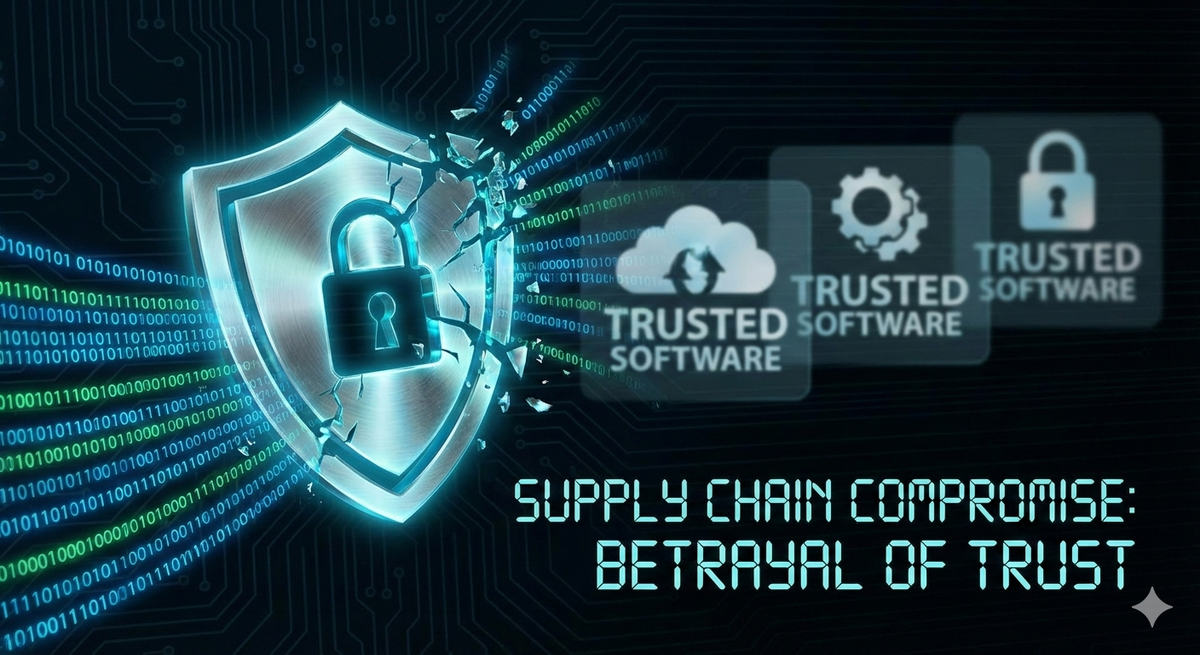
The tools we deploy to protect our organizations are increasingly becoming the vectors through which attackers breach our defenses. In just two weeks, we've witnessed two significant supply chain compromises that should fundamentally reshape how IT leaders approach software trust: the eScan antivirus update server breach and the GlassWorm campaign targeting VS Code extensions. If your security strategy still treats vendor updates as inherently trustworthy, these incidents demand your immediate attention.
The eScan Incident: When Antivirus Becomes the Virus
On January 20, 2026, attackers compromised a regional update server belonging to eScan, an antivirus solution developed by Indian cybersecurity firm MicroWorld Technologies. For approximately two hours, customers downloading updates received malware instead of security patches—delivered via a binary signed with eScan's own legitimate code-signing certificate.
The attack demonstrated sophisticated tradecraft. The malicious update replaced the legitimate Reload.exe updater, created persistence through scheduled tasks under Windows\Defrag\, executed PowerShell payloads, and critically modified the hosts file and registry settings to block eScan's legitimate update servers. The malware effectively neutralized the very tool designed to protect the endpoint.
MicroWorld Technologies detected the intrusion within an hour and took its global update system offline for more than eight hours. However, the damage was done: compromised systems cannot be automatically remediated and require manual intervention through a utility obtained directly from eScan's technical support.
This marks the second time eScan's infrastructure has been exploited—attackers used a vulnerability in 2024 to sideload the GuptiMiner backdoor and XMRig cryptominer onto customer systems.
GlassWorm Returns: Developer Tools Under Siege
Days later, on January 30, 2026, security researchers at Socket identified malicious versions of four established VS Code extensions on the Open VSX Registry. Unlike previous attacks that relied on typosquatting, this campaign compromised a legitimate publisher account with a multi-extension history and strong adoption signals—making detection significantly harder.
The GlassWorm loader embedded in these extensions demonstrated advanced evasion capabilities: runtime decryption, locale-based detonation avoidance (skipping Russian systems), and a novel technique using Solana blockchain transaction memos as a dynamic command-and-control dead drop. This approach allows attackers to rotate infrastructure without republishing extensions.
The campaign harvested browser credentials, cookies, browsing history, and cryptocurrency wallet data from over 35,800 downloads before they were removed. Notably, as of February 2, three affected extensions remained available for download—and even removed extensions don't automatically uninstall from developers' editors.
Why These Attacks Matter for Your Organization: Recognizing the critical impact of these incidents underscores the importance of proactive security measures and IT leaders' role in safeguarding assets. These incidents reflect a broader trend that should alarm every IT leader. According to recent industry analysis, software supply chain attacks have increased threefold in the past year. The World Economic Forum reports that over half of large organizations now identify supply chain complexity as their most significant barrier to cyber resilience.
The attack surface has fundamentally shifted. Adversaries recognize that compromising a single update server or package repository delivers access to thousands of endpoints simultaneously, with the implicit trust organizations place in their security tools providing cover for malicious activity.
The Trust Paradox
Both attacks exploited the same fundamental vulnerability: implicit trust. Security tools receive elevated privileges precisely because we trust them. Developer tools have direct access to source code and credentials. When these trusted channels are compromised, traditional perimeter defenses become irrelevant.
Defensive Strategies: Building Resilient Supply Chain Security
Based on these incidents and emerging best practices, here are actionable recommendations for hardening your organization against supply chain attacks.
Implement Dependency Cooldowns
Configure a 7-14 day delay before accepting new package versions in your development environments. Research indicates that this simple measure would have prevented 8 out of 10 major 2025 supply chain attacks by giving the security community time to identify malicious updates.
Deploy Update Verification Controls
- Require secondary verification for security tool updates, particularly those requesting elevated privileges
- Implement network segmentation that isolates update traffic for monitoring
- Consider updating staging environments where patches are tested before production deployment
- Monitor for unexpected changes to hosts files, scheduled tasks, and registry keys following updates
Strengthen Developer Environment Security
For development teams, the GlassWorm campaign highlights critical gaps:
- Audit installed VS Code extensions quarterly and remove unused packages
- Implement extension allowlisting in enterprise VS Code deployments
- Monitor for extensions accessing browser data, cryptocurrency wallets, or network resources
- Treat developer workstations as high-value targets requiring enhanced monitoring
Adopt Software Bill of Materials (SBOM) Practices
SBOMs provide visibility into your software dependencies, enabling rapid response when components are compromised. Organizations with mature SBOM practices can identify exposure to compromised packages within hours rather than weeks.
Establish Vendor Security Assessment Protocols
Include supply chain security posture in vendor evaluations:
- How do vendors secure their update infrastructure?
- What code-signing practices are employed?
- What incident response capabilities exist for supply chain compromises?
- Has the vendor experienced previous security incidents?
Common Mistakes to Avoid
Treating supply chain security as an ongoing process, rather than a one-time check, helps organizational leaders feel accountable and committed to continuous vigilance against evolving threats.
Assuming signed code is safe code. The eScan attack used legitimate code-signing certificates. Signature verification is necessary but insufficient.
Neglecting developer environments. These systems often have weaker controls than production infrastructure while maintaining access to source code, credentials, and deployment pipelines.
Failing to plan for compromise. Every organization should have a playbook for responding to a compromised vendor, including isolation procedures, communication templates, and recovery processes.
The Path Forward
The eScan and GlassWorm incidents represent an escalating pattern, not isolated events. As AI tools make it easier to replicate exploit patterns and automate code-level probing, we should expect continued attacks on package managers, CI/CD pipelines, and update infrastructure.
Organizations that move now to lock down developer access, enforce dependency trust policies, and continuously verify code integrity will be positioned to avoid being blindsided by the next supply chain compromise.
Sources
- Check Point Research - 2nd February Threat Intelligence Report
- Help Net Security - eScan AV Supply Chain Compromise
- SecurityWeek - eScan Antivirus Delivers Malware in Supply Chain Attack
- Kaspersky Securelist - eScan Supply Chain Attack
- BleepingComputer - eScan Confirms Update Server Breached
- The Register - AV Vendor Disputes Security Shop's Claims
- The Hacker News - Open VSX Supply Chain Attack GlassWorm
- SecurityWeek - Open VSX Publisher Account Hijacked
- BleepingComputer - Open VSX Rotates Tokens
- Risk Ledger - Top 10 Supply Chain Risks 2026
- Dark Reading - Supply Chain Worms 2026
- Secureframe - Supply Chain Attacks 2026